Celera I: Emotional intelligence & self-regulation, by an engineer
I’ve recently been accepted in the Celera program, a 3 year “talent accelerator” program for ambitious Spanish young people that aims at providing support to reach your full potential. It’s been only a few months in and I can already 100% recommend it.
The first year of the program includes sessions with psychologists focusing on “knowing one’s self”. This seems such a simple thing, and something we should definitely have accomplished already, aren’t we all adults after all?? Such a simple thing, yet so important, and so often poorly attended and overlooked through formal education.
Turns out, knowing oneself is not obvious nor trivial at all, so I want to document here the learnings I find most interesting or impactful in my own experience and life. This is the first post of the “Celera series”, where I will cover some notions of emotional intelligence and regulating emotions.
As someone who self-identifies as analytical, who prefers rational decisions over “emotional” ones, I’ve found I’ve been underestimating the role of emotions in human behavior for pretty much all my life. This is very unfortunate, as I’ve now come to understand how important it is to actually understand the mechanics of how I (and others) feel. Looking at the notes I took during the sessions with the psychologists, the common thread is clear: emotions are not just feelings; they have a very clear biological function: our functional compass.
What are emotions for?
Emotions serve a vital purpose. They identify what we are feeling (i.e., “what is happening to me?") so we can name it, communicate it, attend it, and “resolve” it. Importantly, an emotion is a reaction based on our needs. It fulfills the function of informing us so we can take action. This response happens on three levels:
- Physiological: Changes in breath rythm, heart rate, or sweating are examples of physiological responses. For instance, if we are in danger and our safety is compromised in any way, our body may increase our heart beat and breath rhythm.
- Motor: Actions like crying, fleeing, or reaching out are motor responses to emotions.
- Mental: Shifts in thought patterns and changes in attention. Nowadays, this is the most common response, often showing as a cascade of thoughts (remember last time you could not stop thinking about something you were worried about, or afraid from, or excited about?).
Showing emotions or emotional responses publicly is not socially accepted. Hence, we often tend to “repress” our responses, especially the motor and physiological ones, as they could be seen. However, neglecting emotions can evolve into huge burden. Thinking that time will heal our wounds is misleading. With time, something else will happen to you and you will feel other emotions. But whenever the specific situation that caused a certain emotion that was neglected appears, the emotion will emerge.
“An emotion attends to a need."
The idea that time heals all wounds is misleading, and waiting for things to pass is rarely a successful strategy. While time provides new events and stimuly that will eventually shift your attention and trigger new emotions, the original, neglected emotion hasn’t disappeared. The underlying need has not been attended. Whenever a situation mirrors the original event causing it, that neglected emotion will re-emerge.
The socio-emotional wheel (MAT)
One of the most visual parts of the session was the wheel of socio-emotional needs. It maps specific emotions to the fundamental needs they protect:
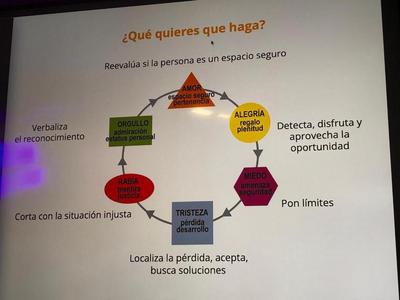
I build the following table to see it more clearly, because this leads to a simple but powerful circular logic: “What does this emotion want me to do?" If the emotion is authentic, the action is clear. Anger wants you to defend yourself from injustice; Fear wants you find safety. When we perform this action (e.g., set limits in case of fear), the emotion fulfills its purpose and dissipates. This is why we should conceive emotions as our functional compass.
Stimulus Emotion Underlying need Action to be taken Threat Fear Safety Set limits Loss Sadness Development Acceptance Injustice Anger Justice Defend justice / rebel Admiration Pride Recognition Acknowledge achievement Safe space Love Belonging Care and attention Opportunity Joy Fullness Enjoy
Sadness is a very interesting emotion, since it’s the one that pushes us to grow and develop. Sadness comes from identifying a loss or a void - something we do not have. It may be a person we no longer have with us, but it can also be lost time, a lost ability, capacity, or means. To transition through and resolve this sadness, we must accept the loss, and find a way to overcome it.
This might mean finding someone who provides a similar support to what the lost person provided, finding a meaningful way to use “lost time,” or learning how to operate without a specific ability we once had. This may sound frivolous, but it is not a matter of finding “substitutes” in a shallow way. It’s simply how we humans work to cover ourvneeds and maintain our well-being when our usual “sources” change. If we lose the source that was meeting a certain need, we must find a new way to provide that for ourselves. Think of it as a somewhat natural “functional resilience”
We often misinterpret or misidentify the authentic emotions we should* be feeling (those that will help us transition through/ resolve that emotion), and sadness is particularly tricky. We often mask loss with other emotions, like anger or fear.
Take the example of a traffic jam: we tend to feel anger (sometimes, a lot of anger indeed!). However, if you dig deep enough, the “authentic” emotion is often sadness: you are experiencing a loss of your valuable time. If you recognize it as sadness, you can “resolve” it by filling that void (for instance, by listening to a podcast). By attending to the actual need (using that time meaningfully), the frustration dissipates.
When thinking of anger (what is an “injustice” to me?), one realization that really struck me is that, as adults, we are “owed” very few things. Essentially, we are only owed respect. I realized I often unconsciously assume people close to me “owe” me certain things, even small favors. Apparently, once we turn adults, we are not really owed anything, even from family or friends. I particularly paid attention to this for a few of weeks, and noticed that when I stop expecting others to “owe” me, I am forced to take more agency over my own needs (both emotional and not).
*What we feel is not right or wrong. However, there is a specific emotion (the “authentic” emotion) that will help us “resolve” or attend the underlying need in a way that we stop or alleviate to a large extent feeling such emotion.
When the compass fails: The dysfunction matrix
Despite the clarity of the wheel introduced above, we often get stuck in emotional dysfunction and dysregulation. Emotional dysfunction happens when we fail to identify the emotion we are feeling (hence we cannot act), when we feel an emotion that is not the “authentic” one we should be feeling upon a stimulus (hence we cannot resolve it), or when we do feel the “authentic” emotion but in a disproportionate degree (dysregulation).
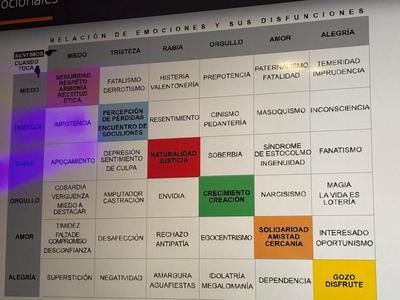
Looking at the matrix of dysfunctions, it becomes clear why we sometimes feel “off”:
- Feeling anger when we should feel sadness leads to hysteria.
- Feeling pride when we should feel anger leads to arrogance.
- Feeling fear when we should feel love leads to lack of trust and commitment.
The goal is to reach a “natural” state: feeling the “authentic” emotion (the diagonal of the matrix) that actually corresponds to the need.
The rider and the elephant
There is an analogy of our emotional self and our rational self called the theory of the Rider and the Elephant.
The rider represents the rational part (long-term thinking, purpose, discipline), whereas the elephant represents the more instinctual, emotional force. They move together, but if they disagree, the elephant is far more powerful. When balanced, we move in the direction the rider guides. The rider attends the needs of the elephant, takes care of it, lets it have its time, and is able to ‘control’ it. If the rider is lost, we’ll move without purpose, the elephant may be fine, but we won’t move in any meaningful direction and might end up stuck or moving in circles for long.
If the elephant is unattended or its needs are continuously dismissed or ignored, the elephant will eventually just ignore the rider and there will be no control over where we go, how we go and whether we can even move. The power of the elephant is way superior in terms of the negative effects it may have in our journey (i.e., in our life).
Strategies for emotional regulation
We are free to manage our responses to emotions. This is a learned skill. I noted two primary styles of regulation:
Bottom-Up (From body to mind): Focuses on the physiological side to calm the emotional side.
- Tools: Breathing, mindfulness, physical exercise, and “catharsis” (e.g., crying, hitting a cushion, or painting).
Top-Down (From mind to body): Focuses on the rationalization of the emotion first.
- Tools: Therapeutic writing, conversation with others, cognitive restructuring, and positive re-evaluation.
Final reflection
The goal is not to avoid “feeling” emotions. We are emotional beings, and are constantly feeling things. The goal is to be able to transition from authentic emotions (those that help solve a need) and avoid false emotions (those we feel but don’t help resolve the underlying issue).
We should experiment with these regulation strategies preventatively. As I wrote in my notes: To move through and resolve emotions is the path to better well-being.
Resources: Respira by James Nestor, Jacobson’s Progressive Relaxation, Haz que cada día salga el sol, El emocionario, This Is Us

Elisa G. de Lope
ML researcher at Keysight Technologies
I bridge the gap between ML and complex problems across physics and biology, specializing in graph representation learning and biomedical data.