Celera I: Emotional intelligence & self-regulation
I’ve recently been accepted in the Celera program, a 3 year “talent accelerator” program for ambitious Spanish young people that aims at providing support to reach your full potential. It’s been only a few months in and I can already 100% recommend it.
The first year of the program includes sessions with psychologists focusing on “knowing one’s self”. This seems such a simple thing, and something we should definitely have accomplished already, aren’t we all adults after all?? Such a simple thing, yet so important, and so often poorly attended and overlooked through formal education.
Turns out, knowing oneself is not obvious nor trivial at all, so I want to document here the learnings I find most interesting or impactful in my own experience and life. This is the first post of the “Celera series”, where I will cover some notions of emotional intelligence and regulating emotions.
As someone who self-identifies as analytical, who prefers rational decisions over “emotional” ones, I’ve found I’ve been underestimating the role of emotions in human behavior for pretty much all my life. This is very unfortunate, as I’ve now come to understand how important it is to actually understand the mechanics of how I (and others) feel. Looking at the notes I took during the sessions with the psychologists, the common thread is clear: emotions are not just feelings; they have a very clear biological function: our functional compass.
What are emotions for?
Emotions identify what is happening to us so we can name it, communicate it, and “resolve” it. An emotion is a reaction based on our needs. This response happens on three levels:
Emotions serve a vital purpose. They identify what we are feeling (“what is happening to me?") so we can name it, communicate it, and “resolve” it. An emotion is a reaction based on our needs. It fulfills the function of informing us so we can take action. This response happens on three levels:
- Physiological: Changes in breathing, heart rate, or sweating.
- Motor: Actions like crying, fleeing, or reaching out.
- Mental: Shifts in thought patterns and changes in attention. Nowadays, this is the most common response, as we tend to “repress” the motor and physiological responses since they are most times not socially accepted.
“An emotion attends to a need."
The socio-emotional wheel (MAT)
One of the most visual parts of the session was the wheel of socio-emotional needs. It maps specific emotions to the fundamental needs they protect:
| Stimulus | Emotion | Underlying Need | Action to be Taken |
|---|---|---|---|
| Threat | Fear | Security | Set limits |
| Loss | Sadness | Development | Acceptance |
| Injustice | Anger | Justice | Self-defense / Resolution |
| Admiration | Pride | Recognition | Acknowledge achievement |
| Safe Space | Love | Belonging | Care and attention |
| Opportunity | Joy | Fullness | Experience plenitude |
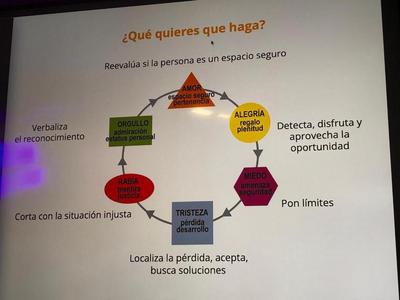
We often mis-interpret or mis-identify the authentic emotions that we should be feeling. For example, we tend to feel anger in a traffic jam. However, if you dig deep enough, it’s sadness that we should be feeling, since it’s a loss of time, and it’s that void that we should fill somehow, for instance, listening to a podcast, to “attend our need” (the loss of our valuable time in this case), and resolve that feeling.
One realization that really striked me is that, as adults, we are “owed” very few things. Essentially, we are only owed respect. This striked me as I guess I tend to think people close to me somehow “owe” me something (??) and I expect them to, for instance do a favor if I ask. I don’t mean necessarily big things, but, you know, small things. Apparently, we are not really owed anything, even from family or friends.
We experience emotions as we interact with stimuli, and we must learn to resolve these emotions by addressing the underlying need they reflect.
Emotional disregulation happens either when we do not identify what we are feeling, when we feel something that is not what we shoud be feeling*, and/or when we feel the “right” emotion but in disproportionate degree.
*What we feel is not right or wrong. However, there is a specific emotion (the “authentic” emotion) that will help us “resolve” or attend the underlying need in a way that we stop or alleviate to a large extent feeling such emotion.
The “Algorithm” of Action
This leads to a simple but powerful circular logic: “What does this emotion want me to do?" If the emotion is authentic, the action is clear. Anger wants you to defend yourself from injustice; Fear wants you to find safety. When we follow this “algorithm,” the emotion fulfills its purpose and dissipates.
When the compass fails: The dysfunction matrix
However, we often get stuck in emotional disfunctions. This happens when we use the “wrong” emotion for a stimulus.
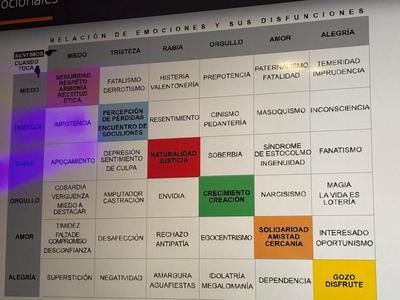
Looking at the session’s matrix of disfunctions, it becomes clear why we sometimes feel “off”:
- Feeling anger when we should feel sadness leads to hysteria.
- Feeling pride when we should feel anger leads to arrogance.
- Feeling fear when we should feel love leads to lack of trust and commitment.
The goal is to reach a “natural” state: feeling the “authentic” emotion (the diagonal of the matrix) that actually corresponds to the need.
The rider and the elephant
There is an analogy of our emotional self and our rational self called the theory of the Rider and the Elephant.
The rider represents the rational part (long-term thinking, purpose, discipline), whereas the elephant represents the more instinctual, emotional force. They move together, but if they disagree, the elephant is far more powerful. When balanced, we move in the direction the rider guides. The rider attends the needs of the elephant, takes care of it, lets it have its time, and is able to ‘control’ it. If the rider is lost, we’ll move without purpose, the elephant may be fine, but we won’t move in any meaningful direction and might end up stuck or moving in circles for long.
If the elephant is unattended or its needs are continuously dismissed or ignored, the elephant will eventually just ignore the rider and there will be no control over where we go, how we go and whether we can even move. The power of the elephant is way superior in terms of the negative effects it may have in our journey (i.e., in our life).
Strategies for emotional regulation
We are free to manage our responses to emotions. This is a learned skill. I noted two primary styles of regulation:
Bottom-Up (From body to mind): Focuses on the physiological side to calm the emotional side.
- Tools: Breathing, mindfulness, physical exercise, and “catharsis” (e.g., crying, hitting a cushion, or painting).
Top-Down (From mind to body): Focuses on the rationalization of the emotion first.
- Tools: Therapeutic writing, conversation with others, cognitive restructuring, and positive re-evaluation.
Final reflection
The goal is not to avoid “feeling” emotions. We are emotional beings, and are constantly feeling things. The goal is to be able to transition from authentic emotions (those that help solve a need) and avoid false emotions (those we feel but don’t help resolve the underlying issue).
We should experiment with these regulation strategies preventatively. As I wrote in my notes: To move through and resolve emotions is the path to better well-being.
Resources: Respira by James Nestor, Jacobson’s Progressive Relaxation, Haz que cada día salga el sol, El emocionario, This Is Us

Elisa G. de Lope
Bioinformatician in ML
My research interests include statistics, data mining, -omics, and drug discovery.